

4 Tips to Improve Breast Cancer Survival
INTRODUCTION
Many of our breast cancer clients ask, “What are the 5- and 10-year breast cancer survival rates?” The next question is: “how can I improve my survival rate?” In this article, I’ll provide the current breast cancer survival rate statistics AND how some breast cancer patients and survivors are improving their survival rates by adopting specific diet and lifestyle habits.
With an ever-growing number of breast cancer cases in the United States (approximately 297,000 per year), breast cancer is now the most frequently diagnosed cancer [1]. Globally, breast cancer has an incidence rate of 11.6% with 2.08 million breast cancer cases out of the total 18.08 million cancer cases that occur globally [4].
Worldwide breast cancer deaths account for 6.6% of all cancer-related deaths, with 626,726 breast cancer deaths reported annually out of 9.55 million total cancer deaths (reported in 2018, [4]). In the United States, there are well over 4 million breast cancer survivors, which includes women who are actively being treated and who have ended their treatment [2].
The focus of the healthcare system now is on helping breast cancer survivors thrive after treatment has ended. That includes preventing a second breast cancer diagnosis.
The determining factor in breast cancer survival is the stage at which the cancer was first identified. The less severe, less invasive the breast cancer is at diagnosis, the higher the survival rate, as seen below [4]:
Stage o and 1 Breast Cancer: Nearly 100% 5-year survival rate
Stage 2 Breast Cancer: 93% 5-year survival rate
Stage 3 Breast Cancer: 72% 5-year survival rate
Stage 4 Breast Cancer: 22% 5-year survival rate
So what can breast cancer survivors do to improve the breast cancer survival rates listed above? Well, science is showing there are specific diet and lifestyle choices that can help improve some of these survival rates, as described in the section detailed below: 8 Tips to Improve Breast Cancer Survival Rates.
TIPS TO IMPROVE BREAST CANCER SURVIVAL
TIP #1: EAT VEGETABLES
The Women’s Healthy Eating and Living (WHEL) study found that all types of vegetables could be promising breast cancer-fighting foods. Over 3,080 breast cancer survivors were questioned about their vegetable intake. The women in this study were diagnosed with their initial breast cancer diagnosis 23 months or longer before being enrolled in this clinical trial. They were also taking the drug tamoxifen.
Women who ate the highest amounts of vegetables had a 44% lower risk of a breast cancer recurrence compared to women who ate the lowest amount of vegetables [1]
TIP #2: EXERCISE
Only half of breast cancer survivors report getting at least 9 metabolic equivalent tasks (MET) -h/week, which equals 30 min of walking daily. And when it comes to healthy eating, again, only half of survivors say they eat at least 5 daily servings of vegetables and fruits [3].
So, when researchers asked 1490 women, with an average age of 50 years, diagnosed with early-stage breast cancer to go through a study looking at how the combination of vegetables, fruits, and exercise affected their risk of death after beating their initial breast cancer diagnosis, the results provided some guidance on what women should do.
Here are some of the characteristics of the women diagnosed with breast cancer seen in this trial:
– 40% were stage I
– 45% were stage II
– 15% were stage III
– The majority were taking tamoxifen
– All were cancer-free, as determined by an oncologist
– The women were within 4 years of diagnosis, with an average time from diagnosis to the study analysis being 8.7 years
The women were asked to provide the amount of vegetables and fruits (V-F) they ate over several weeks. In this analysis, the researchers decided to exclude V-F with low nutritional value: iceberg lettuce, white potatoes, and low-nutrition fruit juices. They also gathered the amount of physical activity (PA) they had, with 3 METs being mild activity, 5 METs being moderate, and 8 METs being vigorous.
The researchers found that women with high daily V-F intake who also had high PA had a 10-year survival rate of 93%. The 10-year survival rate was lower, 86% and 87%, for women who 1) ate low V-F a day and did high PA a day, and 2) ate high V-F and did low PA a day [3].
Eating a high amount of V-F daily and doing high PA every day reduced the mortality rate in women who were normal weight AND obese. This is a significant finding! Science has shown that women who are obese have an increased risk of both new and recurring breast cancer diagnoses [3].
When the researchers teased out the results on the effects of eating just V-F and its affect on the risk of death, they found that the more vegetables the women ate, the lower the mortality rate. Women who ate less than 3.43 servings of fruits and vegetables daily had the highest mortality rate of 12.4%. The more V-F women ate, the more decline the researchers saw in the mortality rates. This effect was seen up to eating 5 servings a day of V-F.
TIP #3: EAT CRUCIFEROUS VEGETABLES
- These are some of the most common types of vegetables eaten in the American diet (e.g., broccoli, cabbage). They have been extensively studied and are considered a cancer-fighting food with solid scientific evidence to back it up. Sow what does the evidence say for breast cancer survivors?
- In The Nurse’s Health Study (NHS) I and II, which surveyed 8,927 women over 40-plus years, cruciferous vegetables decreased the risk of death by any disease by 13% when breast cancer survivors ate at least one serving per day. The women in this study were not all exclusively taking the drug tamoxifen, like the women in the WHEL study [2].
- In the Women’s Healthy Eating and Living (WHEL) study, breast cancer survivors who were taking tamoxifen and ate the highest amount of cruciferous vegetables reduced their risk of a breast cancer recurrence by 35% compared to women who ate the lowest amount of these vegetables [1]
TIP #4: EAT BLUEBERRIES
- Blueberries have long been touted as a food that fights cancer. In the Nurse’s Health Study analysis, breast cancer patients and survivors that ate at least two servings of blueberries a week lowered their risk of death due to breast cancer recurrence by 25%. They also reduced their risk of death by any disease by 17% [2]
- The women ate blueberries for 12 months straight after their breast cancer diagnosis
- There were over 1,000 women who were included in this study analysis, a sizeable number in which to have some confidence in these
GET ALL 8 TIPS ON IMPROVING BREAST CANCER SURVIVAL HERE…
Click here to download our FREE eBook “8 Prevention Facts for Breast Cancer Survivors” which includes 8 facts on how a breast cancer diet and lifestyle lowers the risk of a recurrence. It also includes 3-days of healthy, plant-based recipes.
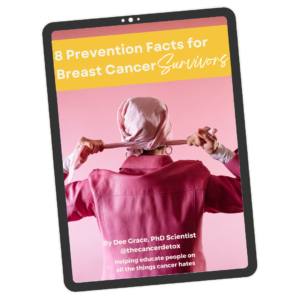
Breast cancer survival guide
FREE RESOURCES
Have more cancer prevention questions? We may have the answers in our free resources. Read or download them now:
1. Download the FREE eBook “HEALTHY FOOD SWAPS” if you’re ready to ditch processed and ultra-processed foods (which are linked to chronic inflammation) with healthier snack options. You’ll also get a list of healthy snacks according to weight and health goals (heart, brain focus, energy)
2. READ about the 10 foods that prevent cancer and our article on 6 Foods for Cancer Prevention
3. Read the article 4 Tips to Improve Breast Cancer Survival along with The Breast Cancer Diet that Increases Survival, then DOWNLOAD the FREE breast cancer survival kit that includes questions to ask your doctor, 8 tips to help lower your risk of a new or recurring breast cancer diagnosis, and 3 days of easy plant-based recipes.
4. Read the article Prevent a Colon Cancer Recurrence and The Optimal Colon Cancer Diet
ABOUT THE CANCER DETOX
Hi! I am Dee Grace Ph.D., scientist, author, and health coach based in Atlanta, Georgia. The Cancer Detox helps cancer patients, survivors, and those wanting to stay ahead of the curve prevent a new or recurring cancer with science-based health coaching.
Is the fear of cancer keeping you up at night? Is what you’re eating putting you at risk for cancer? What if you’re doing everything wrong and don’t even know it? Schedule a complimentary 15-min call with me to get clear on what modern, science-based prevention looks like.
Purchase my book “Cancer Prevention: Diet and Lifestyle Factors that Reduce Your Risk” on Amazon. Pulling from over 100 science-based studies, I provide the case for why cancer isn’t always random and often preventable. You’ll get 24 Prevention Habits that hold you accountable for implementing a cancer prevention lifestyle. along with over 40 cancer prevention guidelines for fighting breast, lung, colon, and prostate cancers.
DISCLAIMER
The information in this article is for educational purposes and is not meant to treat, diagnose, or prescribe medications or herbs. For questions on the information contained in this article, please consult with your healthcare provider. This information is intended for educational purposes only, and you should consult with your healthcare provider and a licensed dietician or certified nutritionist for additional information related to the content of this article.
REFERENCES
[1] SEER Database: Cancer Stat Facts – Female Breast Cancer https://seer.cancer.gov/statfacts/html/breast.html.[2] American Cancer Society: Key Statistics for Breast Cancer https://www.cancer.org/cancer/types/breast-cancer/about/how-common-is-breast-cancer.html#:~:text=At%20this%20time%20there%20are,those%20who%20have%20completed%20treatment.)
[3] Pierce JP et al. Greater survival after breast cancer in physically active women with high vegetable-fruit intake regardless of obesity. J Clin Oncol. 2007;10:2345-2351 [4] Battacharyya